
Virtual Humans: Foundations and Applications
数字人:基础与应用

People 教学团队
Instructor & Lead Teaching Assistants 授课教师 · 主助教



Teaching Assistants 副助教




About the Course 课程介绍
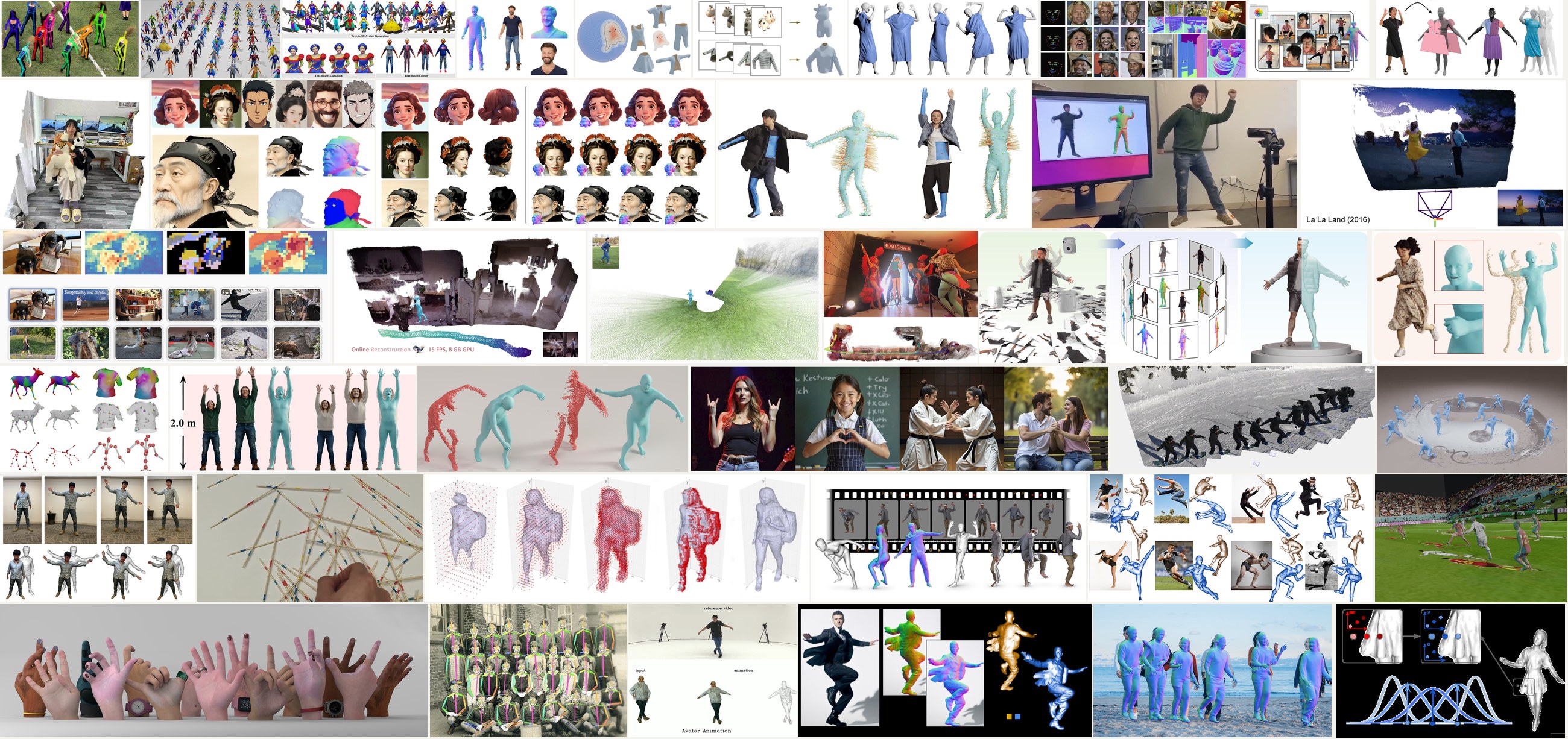
Digital humans aim to create virtual humans with photorealistic appearance, natural motion, and intelligent behavior — a frontier where computer vision, graphics, artificial intelligence, and robotics converge. This course provides a rigorous introduction to the mathematical foundations and state-of-the-art advances in digital human modeling, organized around two pillars that mirror how the field is built: static appearance (geometric representations, parametric models, neural rendering, 3D reconstruction, and garment generation) and dynamic motion (character rigging and skinning, motion capture, inverse kinematics, and physics-based simulation). Along the way we touch on emerging applications including facial animation, crowd and group simulation, speech and audio synthesis, and haptic perception.
By the end of the course, students will master the core technologies for modeling digital humans and build an end-to-end, full-stack pipeline for a personalized, animatable avatar — a foundation equally suited to research or industry. The course blends lectures with hands-on practice, featuring three in-class exams and one open-ended course project.
数字人(Digital Humans)旨在创造外观逼真、动作自然、具备智能行为的虚拟人类,是计算机视觉、计算机图形学、人工智能与机器人学交叉融合的前沿方向。本课程系统讲授数字人建模的数学理论基础与前沿进展,围绕体系构建的两大支柱展开:静态外观(几何表征、参数化模型、神经渲染、三维重建、服装生成)与动态运动(角色绑定与蒙皮、动作捕捉、逆向运动学、基于物理的仿真)。同时延伸介绍面部动画、群体仿真、语音与音频合成、触觉感知等新兴应用。
通过本课程的学习,学生将掌握数字人建模的核心技术,能够构建面向个性化、可动画虚拟人的端到端完整管线,为科研或产业应用奠定坚实基础。课程采用理论讲授与动手实践相结合的方式,包含 3 次随堂考试和 1 个开放性课程项目。
Learning Objectives 学习目标
- Master the mathematical foundations of digital humans — linear algebra, geometry processing, and optimization — and see how they underpin graphics, 3D vision, and foundation models.
- Reconstruct human appearance from diverse visual inputs — single images, video sequences, and multi-view captures — with a solid grasp of parametric models, geometric representations, and neural rendering.
- Model human motion end to end, covering motion capture, inverse kinematics, and character rigging and skinning.
- Assess the strengths and limits of generative AI for avatar creation, and use tools like SMPL, PyTorch3D, Isaac Gym, Hunyuan, and 3DGS.
- Combine appearance modeling with motion synthesis to build high-fidelity, real-time digital human pipelines.
- Read literature critically, reproduce key algorithms, and prepare for research and engineering practice in this field.
- 掌握数字人的数学基础——线性代数、几何处理与数值优化,理解它们如何支撑图形学、三维视觉与多模态基座模型。
- 能够从单图、视频序列、多视角采集等多种视觉输入重建人物外观,并深入理解参数化模型、几何表征与神经渲染等核心技术。
- 端到端建模人体运动,覆盖动作捕捉、逆向运动学与角色绑定和蒙皮技术。
- 客观评估生成式 AI 在数字人创作中的能力与局限,并会使用 SMPL、PyTorch3D、Isaac Gym、Hunyuan、3DGS 等工具。
- 打通外观建模与运动合成,构建面向实时交互的高保真数字人管线。
- 批判性阅读文献、复现关键算法,为科研与工程实践做好准备。
Lecture Schedule 教学日历
| Week | Date | Topic | Instructor | Materials |
|---|
Assessment 成绩评定
| Item / 项目 | Weight / 占比 | Notes / 备注 |
|---|---|---|
| Attendance / 出勤 | 10% | Attendance across 16 lectures / 16 节课出勤 |
| In-class Exam / 随堂考试 | 30% | Three in-class exams / 3 次随堂考试 |
| Project / 课程项目 | 60% | Open-ended course project / 开放性课程项目 |